The short answer
Parents in Germany check contract, total price and support before a student exchange. Minors need their parents' consent under § 107 BGB, the German Civil Code. Organisers owe host-family care for school stays from 3 months under § 651u BGB. Fun, new experiences and another culture matter to 90% of young people surveyed. An exchange organisation only wins the enrolment once it answers both checklists.
About 13,000 teenagers from Germany went to a state school abroad in 2022/23. Each went for at least 3 months through an exchange organisation. The number held at that level up to 2024/25.
The figures come from the weltweiser-Studie 2026, a German market study. Each of these places rests on two checks. The teenager makes one check, and the parents make the other.
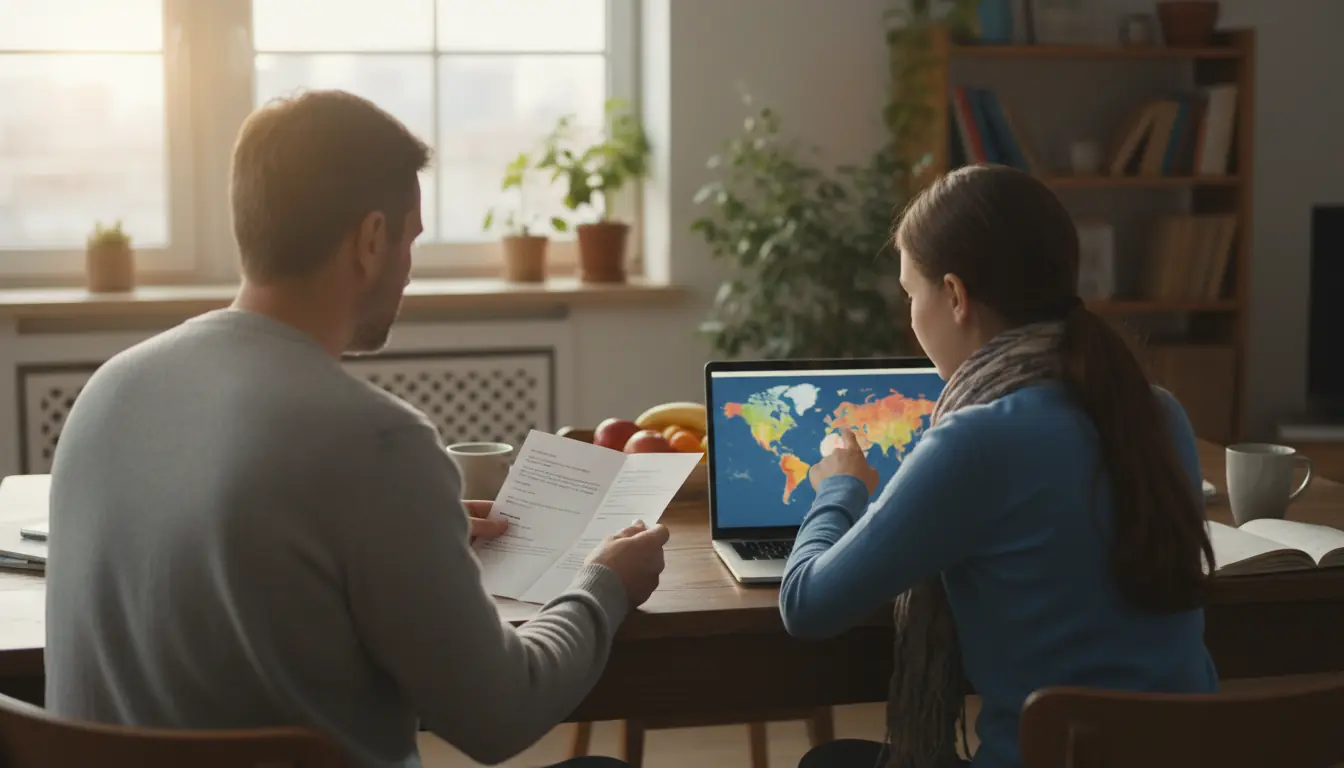
A student exchange runs the 5 stages from trigger to enrolment twice. The parents stand at the last stage, because without them there is no contract. Five reasons explain why they ask different questions from their children.
Parental consent to exchange contracts in Germany
Parents in Germany check the exchange contract because they answer for it. The German Civil Code, the BGB, limits minors' legal capacity from age 7. Under §§ 106 to 108 BGB, minors need parental consent or later approval.
Limited legal capacity means a teenager needs parental consent for a contract. The one exception under § 107 BGB is a contract with only legal advantages. An exchange programme costs money and ties the teenager down for months.
So an exchange contract needs the parents' consent. That gives exchange organisations one simple rule. The enthusiastic teenager starts the talks, and the parents have to sign.
Exchange price and funding for parents in Germany
Parents compare total prices before a student exchange. The German Zugangsstudie of 2018 names expected high costs as an important barrier. The weltweiser-Studie 2026 finds real prices above the minimum prices in Handbuch Fernweh.
The Handbuch Fernweh is a guidebook where exchange organisations present their programmes. Most show their cheapest programme there, so a starting price alone prompts follow-up questions.
3 price details for parents in Germany
- Show the total price, which Germany's price rules in § 3 PAngV require anyway.
- Name income-based grants like Hamburg's: up to €5,000 per pupil a year.
- Explain Auslands-BAföG, German state funding for study, internships and school abroad.
The weltweiser-Studie 2026 lists the Hamburg grant for pupils living in Hamburg. A website that explains such funding answers parents before the first conversation. The portal auslandsbafoeg.de does this for Auslands-BAföG, for example.
Host family and support abroad under § 651u BGB
Parents ask about host family, support and contact person, as German law requires them. The Civil Code, the BGB, covers school stays from 3 months in § 651u. The organiser must provide suitable host-family accommodation, supervision, care and regular schooling.
The same section of the BGB also covers a family's withdrawal before departure. The organiser can then only claim compensation after suitable preparation of the pupil. It must name host family and contact person by 2 weeks before departure.
Duties and conditions for compensation under § 651u BGB
- Duty under subsection 2: suitable accommodation, supervision and care in a host family.
- Duty under subsection 2: conditions for regular school attendance in the host country.
- Condition for compensation after withdrawal under subsection 3: suitable preparation for the stay.
- Condition under subsection 3: name and address of the host family.
- Condition under subsection 3: name and contact details of a contact person abroad.
- Deadline under subsection 3: both details at least 2 weeks before departure.
The weltweiser study counts 5,072 teenagers from Germany in the US in 2024/25. They make up about 39% of all exchange teenagers from Germany.
Canada follows with 3,243 teenagers and New Zealand with 1,266. Over 88% chose the US, Canada, New Zealand, the UK, Ireland or Australia.
College Contact had up to 25 staff at its peak. Ramon Tissler founded Sport Scholarships in 1998, one year after College Contact. He ran this first German agency for US sports scholarships until 2016.
Personal motives for 90% of young people surveyed
Young people choose youth exchange for the experience, says the 2018 Zugangsstudie. Fun, new experiences and another culture matter to 90% of those surveyed. Career prospects and their parents' wishes came up less often.
The SINUS-Institut surveyed 2,380 young people in Germany for the Zugangsstudie. All of them were between 14 and 27 years old. The Robert Bosch Stiftung and the German federal family ministry funded the study.
The study covers all forms of international youth exchange. These include student exchanges, youth meetings, workcamps and voluntary service. The motives for taking part were similar across all social milieus.
Diagram
Parents' and teenagers' checklists for a student exchange
Parents' check points
- Contract and consent
- Total price and funding
- Host family and support
- Contact person in the host country
Teenagers' check points
- Host country and host school
- Fun and new experiences
- A different culture
- Reports from friends
Exchange information sources for teenagers and parents
The 2018 Zugangsstudie names friends and family as main sources on exchange programmes. Many young people in the survey didn't know these programmes existed. Most 12- to 19-year-olds research with search engines, says the JIM-Studie 2025.
We found no published German survey on where parents look for exchange information. The JIM-Studie 2025 and US figures from Carnegie 2025 give a hint.
AI use in the search for education
- German teenagers: about 40% use ChatGPT for their own research.
- US parents: 21% use AI in the college search on a regular basis.
- US students: 23 to 25% use AI in the same way.
The provider weltweiser runs over 60 free events a year on stays abroad. By its own account, these events inform teenagers and parents.
A website has the same task as these events. Every page speaks to teenagers and parents, or names its audience.
In student exchange, many German agencies market their offers side by side with little transparency. Organisations and their placements are hard to compare objectively. When families choose a country, the schools or boarding schools are often not named at all. And in selection interviews, young people are steered towards particular schools, so not every option is open to them.
Exchange website for parents and teenagers
An exchange organisation wins the enrolment when its website answers both checklists. Teenagers look for reports, photos and country information. Parents look for price, contract, support and a contact person.
Both groups meet in the enquiry form. Art. 8 GDPR can set separate data protection rules for under-16s there.
| Check point | Parents | Teenagers | Basis |
|---|---|---|---|
| Contract | give consent or approve | provide the first push | §§ 106 to 108 BGB |
| Costs | compare total price and funding | see high costs as a barrier | § 3 PAngV, Zugangsstudie |
| Support | ask about host family and contact person | ask about host school and daily life | § 651u BGB |
| Motive | parents' wish named less often | fun, new experiences and culture important for 90% | Zugangsstudie 2018 |
| Data | consent for children under 16 | enter contact details in the form | Art. 8 GDPR |
Source: BGB, PAngV, GDPR; Zugangsstudie, Fact Sheet 1/2018
Website for parents and teenagers in 4 steps
- 1Collect parents' questions from advice calls, and answer each on a page for parents.
- 2State the total price per country and programme, and explain funding such as Auslands-BAföG.
- 3Describe how you select host families and who the local contact person is.
- 4Split the enquiry form into parents' and teenagers' details, with parental consent for under-16s.
Art. 8 GDPR covers online services aimed at children under 16. If such a service relies on consent, parents must give or authorise it.
Check each enquiry form or newsletter for pupils under 16 case by case. Reply time and advice then decide how a course enquiry becomes an enrolment.
Frequently asked questions
Can a 16-year-old in Germany book a student exchange on their own?
A 16-year-old in Germany cannot sign a valid exchange contract alone. The German Civil Code, the BGB, limits minors' legal capacity from age 7. They need parental consent or later approval, under §§ 106 to 108 BGB.
What does German law require from an exchange organisation for a school stay?
Exchange organisations must provide a host family for school stays from 3 months. The German Civil Code, in § 651u BGB, also requires supervision, care and regular schooling. After a withdrawal, the organisation only gets compensation after suitable preparation of the pupil. It must name host family and contact person by 2 weeks before departure.
Why do young people in Germany take part in an international exchange?
Young people in Germany join an international exchange above all on their own initiative. The SINUS-Institut surveyed young people aged 14 to 27 for the Zugangsstudie. Of 2,380 respondents, 90% call fun, new experiences and another culture important. Career prospects and parents' wishes came up less often in 2018.
Which countries do exchange students from Germany choose most often?
The US draws the most exchange students from Germany, about 39%. The weltweiser-Studie 2026 counts 5,072 teenagers there in 2024/25. Canada follows with 3,243 and New Zealand with 1,266 exchange students. Over 88% choose the US, Canada, New Zealand, the UK, Ireland or Australia.
When does an exchange organisation need parental consent for data of under-16s?
Art. 8 GDPR requires parental consent for online services aimed at under-16s. The rule applies when the service processes data on the basis of consent. Whether an exchange organisation's enquiry form counts depends on the individual case. Member states may set a lower age limit, but not below 13.
Programme pages with answers for parents and teenagers
We build programme pages that answer parents' questions on safety and costs. They also answer teenagers' questions on the country and the host family. The answers stand as text, so Google and AI systems can use them.
See exchange organisation servicesSources
8 sources. Every figure in the text comes from one of them.
- 1Bürgerliches Gesetzbuch, §§ 106 bis 108 (beschränkte Geschäftsfähigkeit Minderjähriger)Bundesministerium der Justiz, 2026, gesetze-im-internet.deAccessed 10 November 2026
- 2Bürgerliches Gesetzbuch, § 651u GastschulaufenthalteBundesministerium der Justiz, 2026, gesetze-im-internet.deAccessed 10 November 2026
- 3Verordnung (EU) 2016/679 (DSGVO), Art. 8 Bedingungen für die Einwilligung eines KindesEuropean Union, 2016, eur-lex.europa.euAccessed 9 November 2026
- 4Preisangabenverordnung, § 3 Pflicht zur Angabe des GesamtpreisesBundesministerium der Justiz, 2022, gesetze-im-internet.deAccessed 10 November 2026
- 5Warum nicht? Studie zum internationalen Jugendaustausch. Zugänge und Barrieren (Fact Sheet 1/2018)Forschung und Praxis im Dialog, transfer e.V., 2018, zugangsstudie.deAccessed 10 November 2026
- 6weltweiser-Studie Auslandsaufenthalte 2026weltweiser, 2026, weltweiser.deAccessed 10 November 2026
- 7JIM-Studie 2025. Jugend, Information, MedienMedienpädagogischer Forschungsverbund Südwest (mpfs), 2025, mpfs.deAccessed 10 November 2026
- 8Summer Research Series. AI Use in the College SearchCarnegie, 2025, carnegiehighered.comAccessed 10 November 2026

Author
Ramon Tissler
Ramon Tissler has worked in education and online marketing side by side since 1997. He founded College Contact in 1997, a leading placement agency for study abroad. In 1998 he wrote his thesis on online marketing at the University of Lüneburg. Sport Scholarships followed in 1998, the first German agency for US sports scholarships. With International Education Network GmbH & Co. KG he ran the study-abroad fair away and published itchy feet, an education magazine about going abroad. Since 2003 he has run his own online marketing agencies, today MADE-WITH.AI LTD., with education portals such as studyonline.now. He also looks after weltweiser.de and schueleraustausch-weltweit.de, two products of the company weltweiser.